
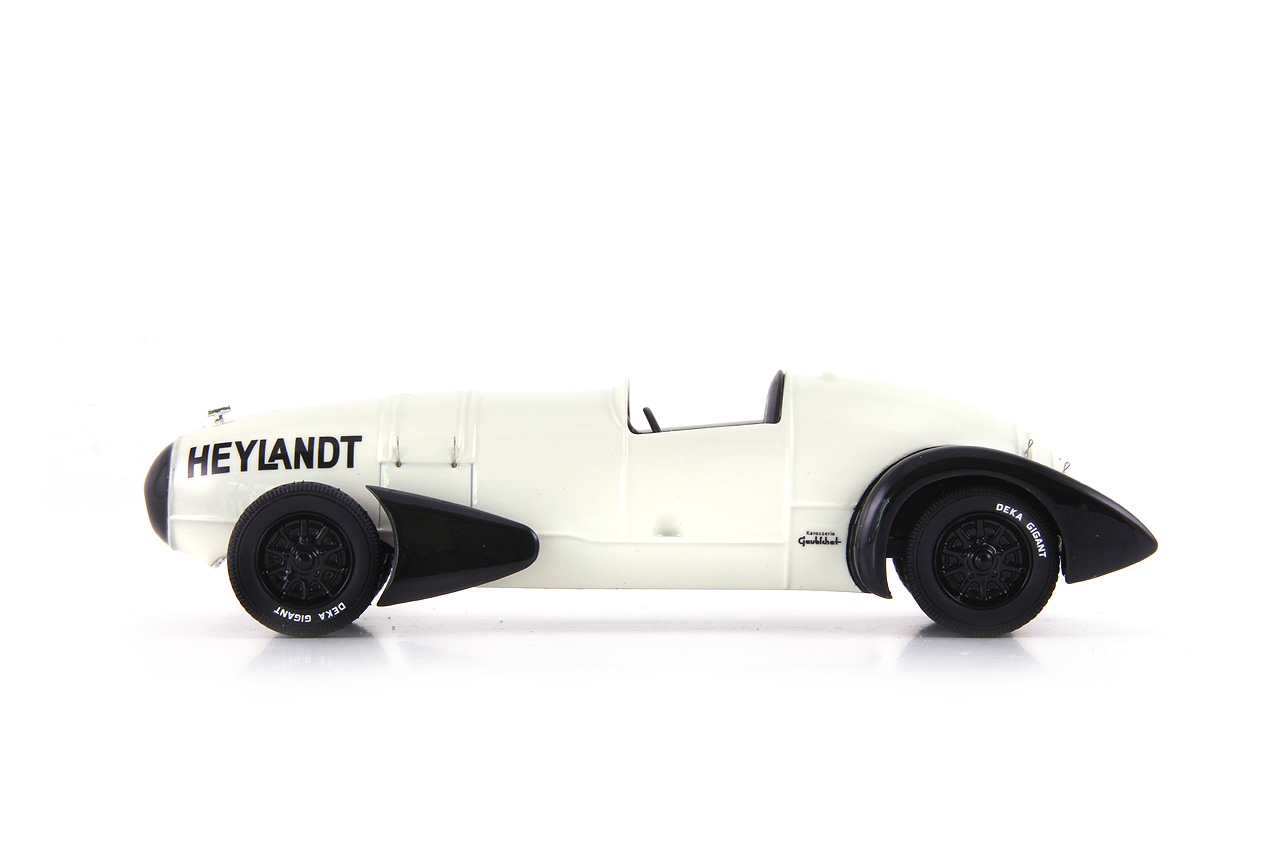
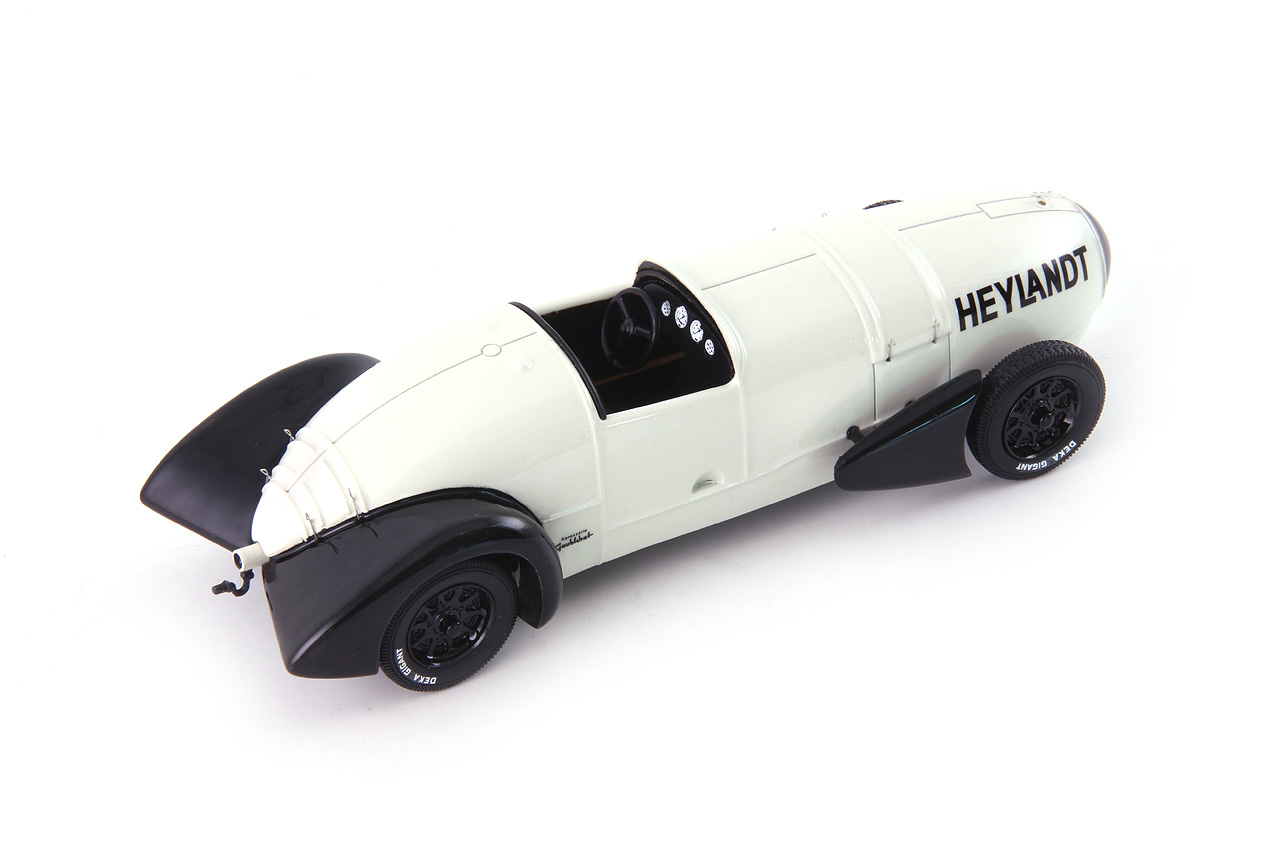
#07034 HEylandt (Germany, 1931)
Scale 1/43



AVAILABLE SOON/ BALD VERFÜGBAR
other languages


Deutsch
Die Rakete für die Straße
Der Name Max Valier ist in der Raketenszene eine bekannte Größe, denn der 1895 in Bozen Geborene gilt als treibende Kraft in der Raketenforschung und hier vor allem in Bezug auf die Forschung zum Flüssigkeits-Raketenmotor. Im Januar 1930 bezog der mittlerweile 35jährige Max Valier eine Werkstätte im Unternehmen Heylandt. Als Testfahrzeug griff er dabei auf ein Auto zurück, das nicht nach optischen und technischen Gesichtspunkten konzipiert war, sondern nur für einem möglichst raschen Vortrieb und eine hohe Geschwindigkeit.
Am 17. April 1930 startete er zum ersten Mal einen Wagen mit Flüssigkeits-raketenantrieb, doch am 17. Mai 1930 verunglückte der Forscher tödlich.
Mit dem Tod des Pioniers versuchte Walter Riedel zusammen mit den Heylandt-Ingenieuren Alfons Pietsch und Arthur Rudolph den Flüssiggasmotor weiterzuentwickeln und das Team schuf ein weiteres Raketenauto, das den Kosenamen `Höllenhund` bekam. Im Mai 1931 unternahm ein Testfahrer auf dem Flughafen Tempelhof erste Fahrten. Der komplette Antrieb wurde mit einem Holzgerüst verschalt und darüber eine Blechkarosse gestülpt wurde, die auch an allen vier Rädern Windabweiser vorsah. Über die Erfolge des an der Front großflächig mit dem Firmenschriftzug Heylandt versehenen, sehr lauten Raketenwagens ist nichts überliefert, vermutlich blieb es auch bei dem einzigen Testlauf im Mai 1931. Weitere automobile Aktivitäten aus dem Berliner Werk sind nicht bekannt, stattdessen traten die Militärs an das Werk heran, erkannten das große Potential des Raketenantriebs und entwickelten ihn weiter für ihre eigenen (vernichtenden) Zwecke.

English
The rocket for the road
The name Max Valier is well known in the rocket scene, as the man born in Bolzano in 1895 is considered a driving force in rocket research, particularly in relation to research into liquid rocket engines. In January 1930, Max Valier, now 35 years old, moved into a workshop at the Heylandt company. As a test vehicle, he used a car that was not designed with visual and technical aspects in mind, but only for the fastest possible propulsion and high speed.
On April 17, 1930, he launched a car with liquid rocket propulsion for the first time, but on May 17, 1930, the researcher was killed in an accident.
Following the death of the pioneer, Walter Riedel, together with Heylandt engineers Alfons Pietsch and Arthur Rudolph, attempted to further develop the liquid gas engine, and the team created another rocket car, which was nicknamed the “Hellhound.” In May 1931, a test driver undertook the first test drives at Tempelhof Airport. The entire drive system was encased in a wooden frame and covered with a sheet metal body, which also featured wind deflectors on all four wheels. Nothing is known about the success of the very loud rocket car, which was emblazoned with the Heylandt company logo on the front, and it is likely that the single test run in May 1931 was the only one ever conducted. No other automotive activities from the Berlin factory are known. Instead, the military approached the factory, recognized the great potential of rocket propulsion, and developed it further for their own (destructive) purposes.

Français
La fusée sur route
Max Valier est une figure emblématique du monde spatial. Né à Bolzano en 1895, il est considéré comme une figure majeure de la recherche sur les fusées, notamment en ce qui concerne les moteurs-fusées à propergol liquide. En janvier 1930, Max Valier, alors âgé de 35 ans, s'installe dans un atelier de la société Heylandt. Pour ses prototypes, il utilise une voiture dont la conception ne tient pas compte de l‘esthétique ni des aspects techniques, mais uniquement de la propulsion et de la vitesse maximale.
Le 17 avril 1930, il effectue le premier “vol terrestre“d'une voiture propulsée par un moteur-fusée à propergol liquide. Malheureusement, le 17 mai 1930, il trouve la mort dans un accident.
Après la disparition de ce pionnier, Walter Riedel, en collaboration avec les ingénieurs de Heylandt Alfons Pietsch et Arthur Rudolph, poursuit le développement du moteur à propergol liquide et crée une autre voiture-fusée, surnommée « Hellhound ». En mai 1931, un pilote d'essai effectua les premiers essais sur l'aéroport de Tempelhof. L’ensemble du système de propulsion était logé dans un châssis en bois, recouvert d'une carrosserie en tôle, équipée de déflecteurs d'air sur les quatre roues. On ignore tout du succès de cette voiture-fusée très bruyante, arborant fièrement le logo de la société Heylandt à l'avant, et il est probable que cet unique essai de mai 1931 ait été le seul jamais réalisé. Aucune autre activité automobile de l'usine berlinoise n'est connue. En revanche, l'armée s'intéressa à l'usine, reconnut le formidable potentiel de la propulsion par fusée et la développa davantage à des fins militaires.

Italiano
Un Missile su strada
Il nome di Max Valier è molto noto nel panorama missilistico: l'uomo, nato a Bolzano nel 1895, è considerato una forza trainante nella ricerca sui razzi, in particolare per quanto riguarda i motori a propulsione liquida. Nel gennaio del 1930, Valier, allora trentacinquenne, si trasferì in un'officina presso l'azienda Heylandt. Come veicolo di prova utilizzò un'auto che non era stata progettata badando all'estetica o agli aspetti tecnici convenzionali, ma esclusivamente per ottenere la massima spinta e velocità possibili.
Il 17 aprile 1930 lanciò per la prima volta un'auto con propulsione a razzo liquido, ma il 17 maggio 1930 il ricercatore rimase ucciso in un incidente. In seguito alla morte del pioniere,
Walter Riedel, insieme agli ingegneri della Heylandt Alfons Pietsch e Arthur Rudolph, cercò di sviluppare ulteriormente il motore a gas liquido; il team creò un'altra auto-razzo, soprannominata "Hellhound" (il segugio infernale). Nel maggio del 1931, un collaudatore effettuò i primi giri di prova presso l'aeroporto di Tempelhof. L'intero sistema di propulsione era racchiuso in un telaio di legno e coperto da una carrozzeria in lamiera, che presentava anche dei deflettori d'aria su tutte e quattro le ruote. Non si sa nulla del successo di questa rumorosissima auto-razzo, che sfoggiava il logo della Heylandt sul frontale, ed è probabile che quella prova del maggio 1931 sia stata l'unica mai condotta. Non sono note altre attività automobilistiche della fabbrica berlinese; al contrario, i militari si avvicinarono all'azienda, ne riconobbero il grande potenziale bellico e svilupparono ulteriormente la propulsione a razzo per i propri scopi distruttivi.
