
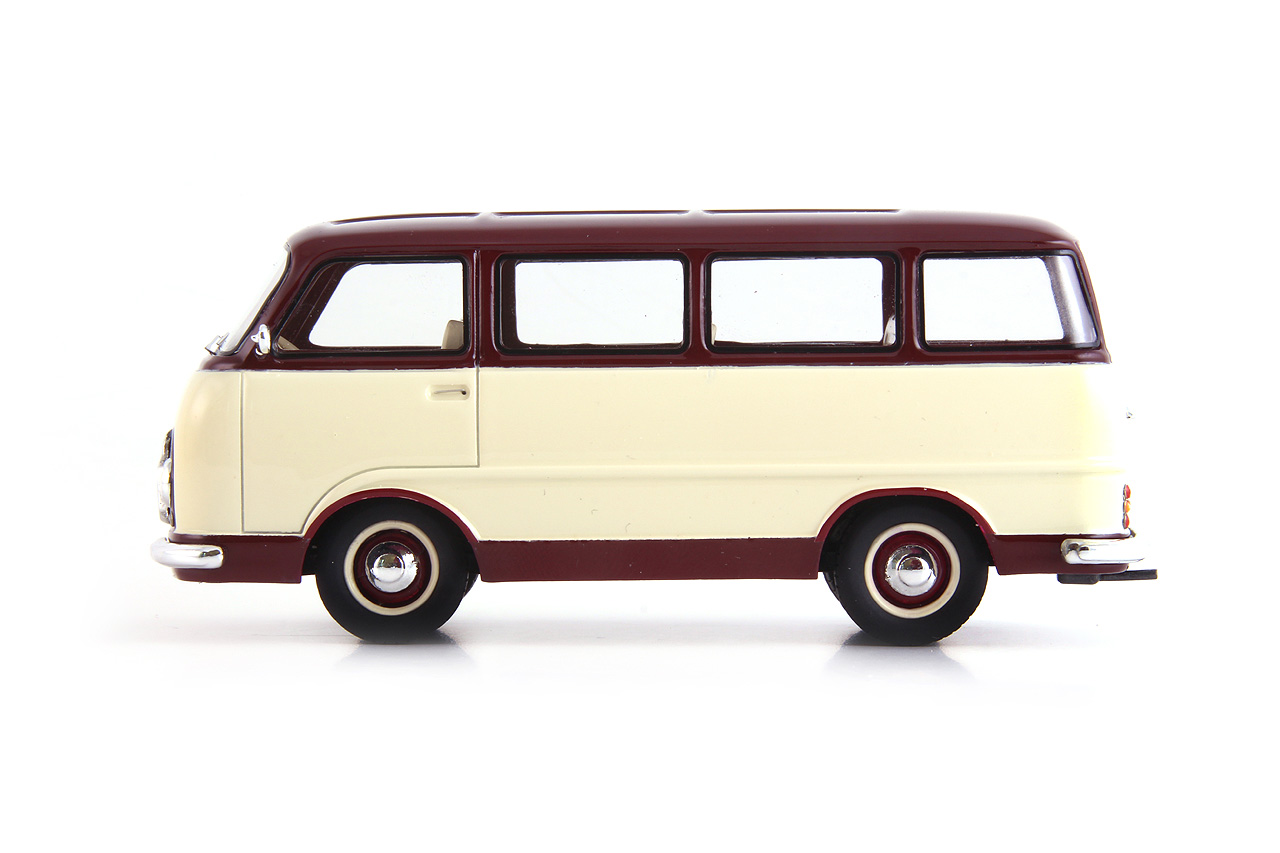
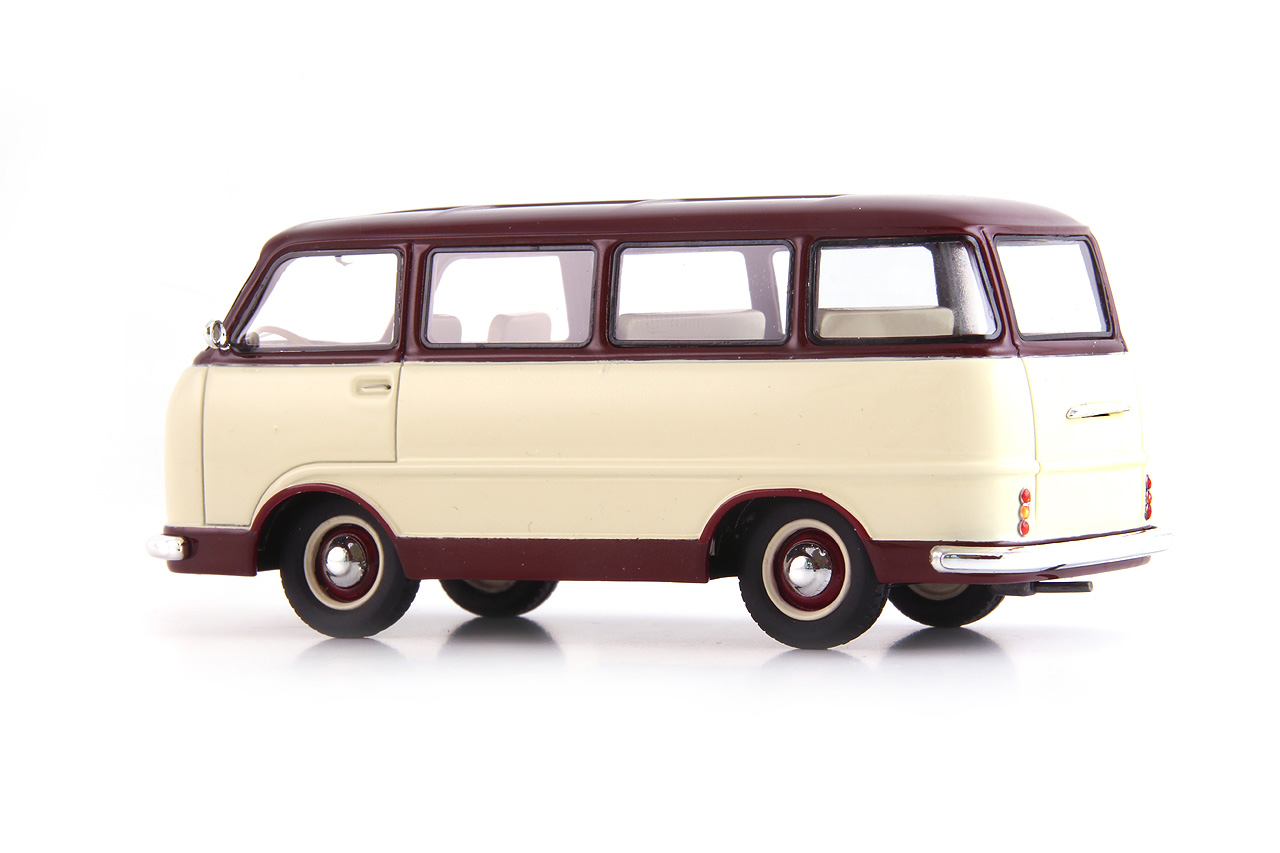
#08024 Skoda 979-I (Czech Republic, 1956)
Scale 1/43



other languages


Deutsch
Viel Mühe, kein Erfolg
1955 gab es in der CSSR aus dem Ministerium für Automobilindustrie grünes Licht für den Aufbau eines Nutzfahrzeugs, das die Attribute geräumig, leicht und modern zu erfüllen hatte. Der zukünftige Van sollte eine Tragfähigkeit von 950 kg haben, die Höchstgeschwindigkeit musste annähernd 100 km/h betragen und der Verbrauch sollte sich auf circa 10 Liter Benzin für 100 Kilometern beschränken.
Mit diesen Eckdaten wurde der erste Versuchsträger im Hause Škoda aufgebaut, der hausintern unter der Typenbezeichnung S 979 geführt wurde. Ab März 1956 entstand der Kleintransporter auf dem Zeichenbrett und bereits sechs Monate später konnte er als Prototyp unter realen Bedingungen gefahren werden. Die Arbeiten wurden in den beiden Werke Mladá Boleslav und Vrchlabí ausgeführt. Von der Optik her wirkte der Van keineswegs attraktiv. Dem Kleintransporter haftete - aus heutiger Sichtweise - der Hauch eines sozialistischen Fahrzeugs an, der durch seine pessimistisch dreinblickende Front mit der unglücklich farblich abgesetzten Hervorhebung und dem verchromten Kühlergrill mit den beiden Scheinwerfern kein glückliches Gesicht bot.
Es kann angenommen werden, dass gerade diese Optik auch den maßgeblichen Herren nicht gefiel und der kleine Van wohl auch deswegen keine Erlaubnis für einen Serienbeginn bekam. Ob es noch andere Kritikpunkte an diesen ersten Prototypen gab, ist nicht überliefert, die Front gehörte jedoch dazu, denn schon bei der nächsten Version wurden die Scheinwerfer und die gesamte Partie weitaus kräftiger nach vorne ausmodelliert.

English
A lot of effort, no success
In 1955, the Czechoslovakian Ministry of Automotive Industry approved the development of a commercial vehicle that had to be spacious, lightweight, and modern. The future van was designed to have a load capacity of 950 kg, a top speed of approximately 100 km/h, and fuel consumption of around 10 liters per 100 kilometers.
Keeping these specifications in mind, Škoda built the first test vehicle and gave it the internal type designation S 979. Work on the small transporter began in March 1956, and just six months later, a prototype was ready for testing under real-world conditions. This work was carried out at the two plants in Mladá Boleslav and Vrchlabí. Visually, the van was not attractive. From today's perspective, it had the flair of a socialist vehicle with its pessimistic-looking front end, unfortunate color accents, and chrome radiator grille with two headlights that did not present a happy face.
It can be assumed that this appearance did not appeal to the decision-makers and was one reason the small van was not approved for production. While it is unclear if there were other criticisms of the first prototype, the front end was certainly one of them. In the next version, the headlights and entire front section were much more prominent.

Français
Beaucoup d’efforts, mais pas de succès.
En 1955, le ministère tchécoslovaque de l'Industrie automobile approuva le développement d'un véhicule utilitaire spacieux, léger et moderne. La future fourgonnette devait avoir une capacité de charge de 950 kg, une vitesse de pointe d'environ 100 km/h et une consommation de carburant d'environ 10 litres aux 100 kilomètres.
En tenant compte de ces spécifications, Škoda construisit le premier prototype et lui attribua la désignation interne S 979. Les travaux sur ce petit transporteur commencèrent en mars 1956 et, six mois plus tard seulement, un prototype était prêt pour les essais en conditions réelles. Ces essais furent menés dans les deux usines de Mladá Boleslav et de Vrchlabí. Esthétiquement, la fourgonnette n'était pas attrayante. Avec le recul, elle avait le style typique des véhicules socialistes : une face avant à l'air pessimiste, des touches de couleur peu flatteuses et une calandre chromée à deux phares qui ne semblait pas exprimer un grand sourire.
On peut supposer que cette apparence n'a pas plu aux décideurs et que c'est l'une des raisons pour lesquelles le petit fourgon n'a pas été approuvé pour la production. Bien qu'il soit difficile de savoir si le premier prototype a fait l'objet d'autres critiques, la face avant en était certainement une. Dans la version suivante, les phares et toute la partie avant étaient beaucoup plus proéminents.

Italiano
Molto impegno, nessun successo
Nel 1955, il Ministero dell’Industria Automobilistica cecoslovacco approvò lo sviluppo di un veicolo commerciale che doveva essere spazioso, leggero e moderno. Il futuro furgone fu progettato per offrire una capacità di carico di 950 kg, una velocità massima di circa 100 km/h e un consumo di carburante di circa 10 litri ogni 100 chilometri.
Tenendo a mente queste specifiche, la Škoda costruì il primo veicolo sperimentale, al quale assegnò la designazione interna S 979. I lavori sul piccolo trasportatore iniziarono nel marzo del 1956 e, appena sei mesi dopo, era già pronto un prototipo per i test in condizioni reali. Le prove si svolsero negli stabilimenti di Mladá Boleslav e Vrchlabí. Dal punto di vista estetico, il furgone non risultava attraente. Oggi, il suo aspetto trasmette l’aria tipica di un veicolo socialista, con il frontale dall’espressione cupa, le combinazioni cromatiche poco riuscite e una griglia cromata con due fari che non trasmettevano certo simpatia.
Si può presumere che questo aspetto non avesse convinto i responsabili decisionali e che fosse una delle ragioni per cui il piccolo furgone non venne approvato per la produzione. Non è chiaro se vi fossero altre critiche verso il primo prototipo, ma il frontale fu sicuramente uno dei punti più discussi. Nella versione successiva, infatti, i fari e l’intera sezione anteriore divennero molto più marcati e moderni.
