
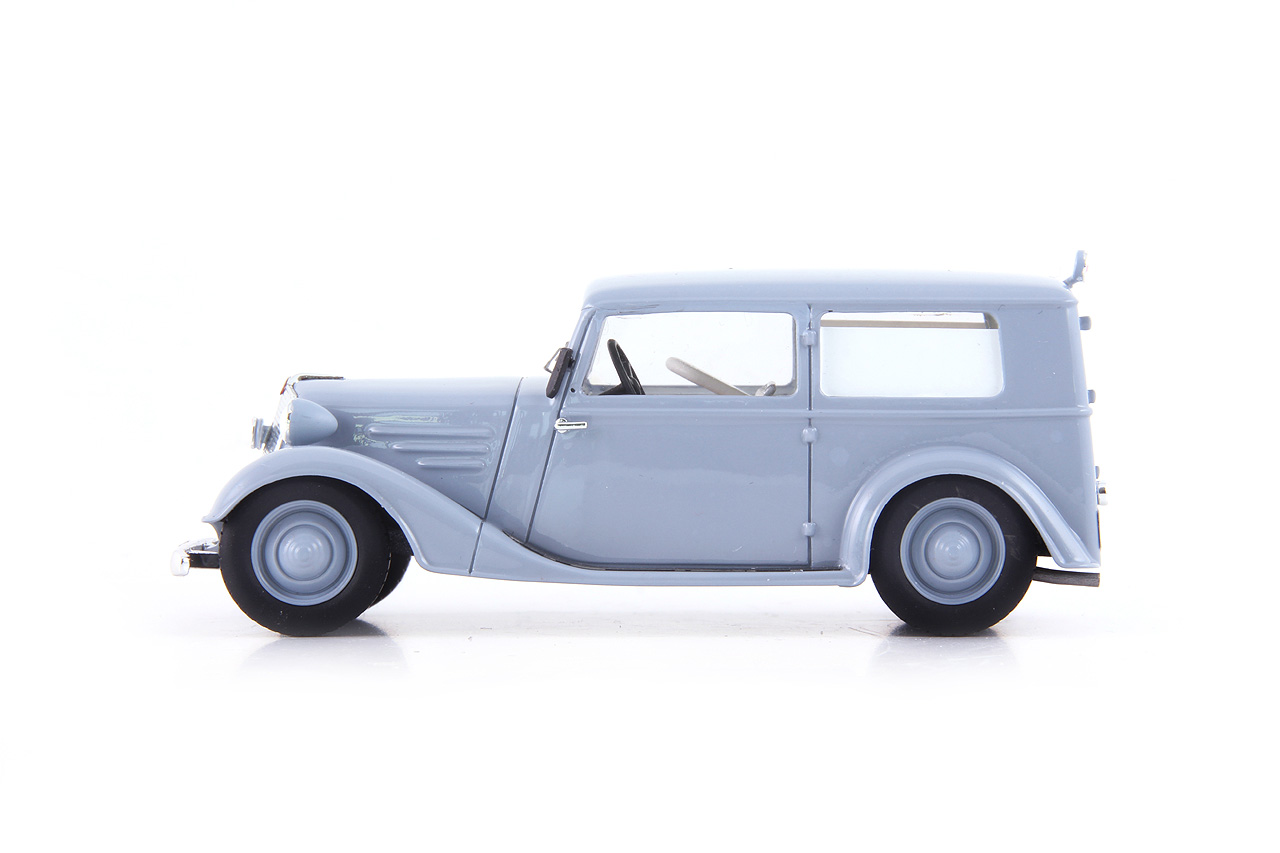
#12022 Tatra 57B Sanitka Sodomka (Czech Republic, 1940)
Scale 1/43



AVAILABLE SOON/ BALD VERFÜGBAR
other languages


Deutsch
Der Versuch
Als der Tatra 57 B im Jahr 1938 präsentiert wurde, bestand der Wunsch, diesen Personenwagen auch als Sanitätswagen zu nutzen. Der Auftrag, dies in Realität umzusetzen ging an das damals bekannt renommierte Karosserieunternehmen `Carrosserie Sodomka`. Die geschickten Modellbauer und Mechaniker in Vysoké Mýto schneiderten das neue Blechkleid so, dass ein Patient auf einer per Rollen schiebbaren Trage in liegendem Zustand transportiert werden konnte - mangels Länge des gesamten Fahrzeugs nahm die Trage höchstwahrscheinlich die gesamte Länge von knapp hinter der Heck- bis zur Frontscheibe in Anspruch. Einzig über eine an der linken Seite angeschlagenen Hecktür war der spärliche Innenraum zugänglich, denn neben der Trage fand nichts Weiteres Platz darin. Dies entsprach dem damaligen Gedanken eines Krankentransports und zwei kleine, runde Signalleuchten mit dem roten Kreuz am Kühlergrill und am Dach des Hecks machten den Tatra 57 B als Sanitätswagen optisch erkennbar. Zudem deuteten auch die obligatorisch halb abgedeckten Scheiben auf diesen Verwendungszweck hin.
Über den Werdegang den Versuchsträgers ist außer den überlieferten Fotos nichts bekannt, gesichert ist jedoch, dass er ein Unikat blieb und nicht überlebte. Ob die politische Entwicklung in dieser kurzen Vorkriegszeit einer eventuell geplanten Serienfertigung im Wege stand, kann nicht ausgeschlossen werden.

English
It remained an Attempt
When the Tatra 57 B was unveiled in 1938, there was a desire to use this passenger car as an ambulance. The task of turning this into reality was given to the renowned coachbuilder Carrosserie Sodomka. The skilled model builders and mechanics in Vysoké Mýto tailored the new bodywork so that a patient could be transported lying down on a stretcher that could be moved on rollers. Due to the lack of length of the entire vehicle, the stretcher most likely took up the entire length from just behind the rear window to the windshield. The sparse interior was only accessible via a rear door hinged on the left side, as there was no room for anything else besides the stretcher. This was in line with the thinking at the time about patient transport, and two small, round signal lights with a red cross on the radiator grille and on the roof at the rear made the Tatra 57 B visually recognizable as an ambulance. The mandatory half-covered windows also indicated this intended use.
Apart from the photos that have been handed down, nothing is known about the history of the vehicle, but it is certain that it remained a one-off and did not survive. It cannot be ruled out that political developments in this short pre-war period stood in the way of any planned series production.

Français
L'Expérience
Lors de la présentation de la Tatra 57 B en 1938, l'idée de transformer cette voiture de tourisme en ambulance germait. La réalisation de ce projet fut confiée au carrossier de renom de l'époque, Carrosserie Sodomka. Les talentueux maquettistes et mécaniciens de Vysoké Mýto adaptèrent la nouvelle carrosserie afin qu'un patient puisse être transporté allongé sur une civière montée sur roulettes. Compte tenu de la longueur réduite du véhicule, la civière occupait probablement toute la longueur, de l'arrière jusqu'au pare-brise. L'intérieur spartiate n'était accessible que par une porte arrière à charnières latérales gauche, faute de place pour autre chose que la civière. Cette configuration reflétait la conception alors en vigueur du transport de patients, et deux petits feux ronds à croix rouge, apposés sur la calandre et le toit arrière, identifiaient visuellement la Tatra 57 B comme une ambulance. Les vitres semi-occultées, obligatoires, confirmaient également cette vocation.
Hormis les photos qui nous ont été transmises, on ignore tout de l'histoire de ce véhicule, mais il est certain qu'il est resté un prototype unique et n'a pas été reproduit. On ne peut exclure que le contexte politique de cette brève période d’avant-guerre ait entravé toute production en série envisagée.

Italiano
Rimase giusto un’ipotesi
Quando la Tatra 57 B fu svelata nel 1938, nacque il desiderio di utilizzare questa vettura passeggeri come ambulanza. L'incarico di trasformare l'idea in realtà fu affidato alla rinomata carrozzeria Sodomka. Gli esperti modellisti e meccanici di Vysoké Mýto modellarono la nuova carrozzeria in modo che un paziente potesse essere trasportato sdraiato su una barella scorrevole su rulli.
A causa della lunghezza ridotta del veicolo, la barella occupava molto probabilmente l'intero spazio disponibile, da poco dietro il lunotto fino al parabrezza. All'abitacolo, estremamente essenziale, si poteva accedere solo tramite un portellone posteriore incernierato a sinistra, poiché non vi era spazio per nient'altro oltre alla barella stessa. Ciò era in linea con la concezione dell'epoca riguardo al trasporto dei pazienti; due piccole luci di segnalazione rotonde con una croce rossa, poste sulla griglia del radiatore e sul tetto nella parte posteriore, rendevano la Tatra 57 B visivamente riconoscibile come ambulanza. Anche i finestrini obbligatoriamente oscurati per metà ne indicavano l'uso previsto.
Oltre alle foto tramandate, non si sa nulla della storia del veicolo, ma è certo che rimase un esemplare unico e non è sopravvissuto fino ai giorni nostri. Non si può escludere che gli sviluppi politici di quel breve periodo prebellico abbiano ostacolato qualsiasi piano di produzione in serie.
